Dear Flannery,
"For my money, Dante is about as great as you can get."
You wrote that in a letter to “A” in 1955. I was chatting with a visitor in my home two days ago and mentioned that I had just finished reading Dante's Divine Comedy as part of my attempt to fill in some gaping holes in my literary education. (I mentioned this ongoing project to you earlier. I have been making some progress lately through my book stacks and although I grasp very little I find myself miraculously becoming a bit less confused which I constantly remind myself is all I can hope for.) This visitor whom I believe is college-educated mumbled quite humbly that she never even heard of Dante. I strove to hide my disappointment. Never heard of Dante? How can this happen? This is the unsettling and sometimes astonishing state of modern affairs.
You saw this in your time and it has become much, much worse. Not many are interested in the accumulated wisdom of the world anymore. The great majority of teachers don’t teach it so students never hear of it. Or is it that teachers don’t instill a love of learning so people grow up with no interest in it? Or could it be that our “advanced technological age” makes both entertainment and learning equally and instantly accessible and we humans characteristically choose mindless amusements over knowledge? It could just be the pervasive new-age attitude that old is valueless, new is best (or what people perceive as old and new). If the ancient or old is referred to at all, it is often twisted to suit shallow and misguided modern sensibilities. And that’s sad, wrong, and ignorant. As if just because we are living in the present time we are smarter, better human beings than those who came before. Since when has that ever been true?
I was thrilled to find at the touch of my fingertips, glowing on my computer screen, a lengthy paper from 1989 called “Flannery O’Connor and Dante’s Divine Comedy” by Benjamin B. Alexander, a lecturer and assistant university professor of English and Religion. This I printed out at another touch for perusal at my convenience. Incidentally, all this amazing modern facilitation I enjoy makes me think of you laboriously typing and retyping your stories and novels on a mid-20th century typewriter, painstakingly making corrections--with what, an ink eraser? And then sending out precious copies to editors and publishers. (I think I remember reading that you eventually got an electric typewriter which must have been nice but not much technical help.) Beyond that, it makes me think of Dante himself, writing in the Middle Ages . . . with what? (Wait, I’ll look it up on Google.) Wax tablets, perhaps (he was probably too poor to employ a scribe), and then pen and parchment. In elegant script. No, we have no excuse nowadays, for any sort of laziness in learning or writing, do we?
You may be surprised and pleased that Alexander finds striking similarities between your writings and our esteemed 14th Century Italian’s. Both of you wrote to illuminate the divine life, or the Holy Spirit, in everyday people’s lives. He says you parallel Dante in the crafting of your stories. Yes, I believe I can see that. He goes on to acknowledge that while Dante lived in a time when he could take for granted that the people around him shared his view of heaven and hell as “unquestionable truth,” you lived in a world of “pluralistic options and existential dilemmas” when all things God had become “a conditional alternative.” There was no longer a universally shared faith. In other words, you had extenuating circumstances Dante did not have to contend with.
A world losing both its faith and its certainties was the world you wrote for, an “age with doubts both fact and value, and which is swept this way and that by momentary convictions.” Even so, you would not recognize the world we live in today. You would see those momentary convictions flowing mainstream from our new god, Secularism, the new fountain of “truth,” decorated with demonic distortions, violence, and filth right out of the Inferno. Dante’s readers recognized the hellish as “deformed and perverse, whereas contemporary culture increasingly equates hellish iconography with the normative and chic.” Alexander wrote these words over 20 years ago, and in the last outrageous and unprecedented 20 years, things have gotten worse.
It’s really become quite unfriendly here for those who believe this world is not our real home, who care about the welfare of immortal souls, who exercise faith that there is a spiritual universe we can begin to explore and know here and now. Even churches of every denomination have been caught up in the popular secular current. Their once firm doctrines are now diluted and watery and swirl among shallow, liquid, ever-changing sophistries. As a result, for some, sitting in a crowded chapel on a Sunday feels like the loneliest place on earth.
Glimpsing light from Dante’s “dark wood,”
J.
Monday, May 2, 2011

Wednesday, March 2, 2011
Letter #7
Dear Flannery,
Sorry I haven’t written in several weeks. I have been across the country and very busy staying with my daughter who has one-year-old triplets who got sick. Can you imagine one person caring around the clock for three coughy, runny-nosed, whiny, clingy, sleepless, inconsolable, heavy babies? One is enough to drive a person to distraction. Of course her husband is a good help but he’s at work all day. To top it off she caught whatever they had and was pretty sick at the same time and really needed some help. It was quite intense there for a week or so of my stay. But gradually they all grew blessedly well again, laughing, toddling, playing, and making great healthy messes of all kinds, and now I am home again. I have made many such trips since the dear babies were born and it's always an adjustment at either end of the journey. Whereas for weeks I have been changing, wiping, dressing, bathing, feeding, carrying, rocking, and singing favorite silly songs in a self-contained all-baby universe, I am now experiencing the quiet shock of participating in my ordinary solitary pastimes.
This latest experience with the triplets reminds me how different my life has been from yours. Aside from us both being female, Caucasian, American, and Christian, I don’t know how two lives could be more different. You grew up in Georgia, I grew up in California and Guam. You were raised Catholic and I was raised in an evangelical Christian religion. You were 15 when your father died, I was 54. You were single, I married young. You excelled in college, I never finished. You had no children, I have seven, and 15 grandkids. You were a genius, I am not. You were a famous writer, I am only a writer. You got sick and passed on at 39, and I have always been healthy and am 56 and still here.
And yet . . . and yet . . . as far as I can see, we share some very basic and deep beliefs about the most important things, and that sameness feels infinitely more important than all of the above differences. Yes, even more important than places and people and churches and accomplishments and temporal circumstances. Even more important than life and even more important than death. This is why I call you friend. There is so much to say!
Back to reading and writing,
J.
Sorry I haven’t written in several weeks. I have been across the country and very busy staying with my daughter who has one-year-old triplets who got sick. Can you imagine one person caring around the clock for three coughy, runny-nosed, whiny, clingy, sleepless, inconsolable, heavy babies? One is enough to drive a person to distraction. Of course her husband is a good help but he’s at work all day. To top it off she caught whatever they had and was pretty sick at the same time and really needed some help. It was quite intense there for a week or so of my stay. But gradually they all grew blessedly well again, laughing, toddling, playing, and making great healthy messes of all kinds, and now I am home again. I have made many such trips since the dear babies were born and it's always an adjustment at either end of the journey. Whereas for weeks I have been changing, wiping, dressing, bathing, feeding, carrying, rocking, and singing favorite silly songs in a self-contained all-baby universe, I am now experiencing the quiet shock of participating in my ordinary solitary pastimes.
This latest experience with the triplets reminds me how different my life has been from yours. Aside from us both being female, Caucasian, American, and Christian, I don’t know how two lives could be more different. You grew up in Georgia, I grew up in California and Guam. You were raised Catholic and I was raised in an evangelical Christian religion. You were 15 when your father died, I was 54. You were single, I married young. You excelled in college, I never finished. You had no children, I have seven, and 15 grandkids. You were a genius, I am not. You were a famous writer, I am only a writer. You got sick and passed on at 39, and I have always been healthy and am 56 and still here.
And yet . . . and yet . . . as far as I can see, we share some very basic and deep beliefs about the most important things, and that sameness feels infinitely more important than all of the above differences. Yes, even more important than places and people and churches and accomplishments and temporal circumstances. Even more important than life and even more important than death. This is why I call you friend. There is so much to say!
Back to reading and writing,
J.
Wednesday, December 29, 2010
Letter #6
Dear Flannery,
I have this memorized: “. . . to the hard of hearing you shout, and for the almost-blind you draw large and startling figures.” It is your explanation of why you wrote like you did, “. . . forced to take ever more violent means to get [your] vision across to this hostile audience.” In the days before I met you, I was a member of that hostile audience, one of those who needs to be hit over the head with a sledgehammer in order for anything of lasting value to get in. I found you at just the right time, when God had suffered that my soul undergo that violence and was at last laid open to hear and see truth wherever it happened to show itself.
I purposely entered one of those fancy bookstores with the coffee shop in it to find your story assigned by Elizabeth Kantor and found it in a navy blue paperback called Three by Flannery O’Connor. The collection edition has what I soon learned was somewhat misleading modern art on the cover—earth-toned, sinewy, effusive figures divided by skin color—from a panel from The Arts of Life in America: Arts of the South. Of course your stories do take place in the South but are not about region or race, and do not end with earthly sufferings and strivings. You put your characters in that inordinately complex place we call the South to give them a sense of the concrete, to make them live. But these people you wrote about are all of us, inside, everywhere.
After reading the story, “Everything That Rises Must Converge,” I started at the beginning of the book with your first novel, Wise Blood. Talk about a sledgehammer to the soul! Now I have read this novel at least three times. Every time I read the last page I feel I must read the whole book again to make sure I understand what that Hazel Motes was really about.
Yours truly,
Another Christian malgre lui (in spite of herself)
I have this memorized: “. . . to the hard of hearing you shout, and for the almost-blind you draw large and startling figures.” It is your explanation of why you wrote like you did, “. . . forced to take ever more violent means to get [your] vision across to this hostile audience.” In the days before I met you, I was a member of that hostile audience, one of those who needs to be hit over the head with a sledgehammer in order for anything of lasting value to get in. I found you at just the right time, when God had suffered that my soul undergo that violence and was at last laid open to hear and see truth wherever it happened to show itself.
I purposely entered one of those fancy bookstores with the coffee shop in it to find your story assigned by Elizabeth Kantor and found it in a navy blue paperback called Three by Flannery O’Connor. The collection edition has what I soon learned was somewhat misleading modern art on the cover—earth-toned, sinewy, effusive figures divided by skin color—from a panel from The Arts of Life in America: Arts of the South. Of course your stories do take place in the South but are not about region or race, and do not end with earthly sufferings and strivings. You put your characters in that inordinately complex place we call the South to give them a sense of the concrete, to make them live. But these people you wrote about are all of us, inside, everywhere.
After reading the story, “Everything That Rises Must Converge,” I started at the beginning of the book with your first novel, Wise Blood. Talk about a sledgehammer to the soul! Now I have read this novel at least three times. Every time I read the last page I feel I must read the whole book again to make sure I understand what that Hazel Motes was really about.
Yours truly,
Another Christian malgre lui (in spite of herself)
Monday, December 20, 2010
Letter #5
Dear Flannery,
What I really mean by you being dead is that you have passed on to another realm of existence where you are busily engaged in what is most important because that is the kind of person you were here and I’m certain we don’t change from here to there but remain the same sort of person with the same feelings and wishes and beliefs. You thought so too when you said “those qualities least dispensable” in our personalities here are the ones we “will have to take into eternity” with us.
I don’t want you worrying that I’m going to track you down first thing when I get to where you are. That is not what I mean to do. Oh, sure, there are a lot of dead authors I’d like to thank or meet or know, but I don’t think this is how it will be. I think, in the Most Hopeful Place in question, among those there, all of what is thought of as admiration and appreciation for each other will automatically bounce right off us previously mortal people and land squarely on the Right Being.
I also don’t want you worrying about my being obsessed with these things, in the way the world thinks of being obsessed with religion. No, I don’t keep peacocks like you did, but I do have plenty of other interests (even though I admit they all point back to what I care most about).
You should see it now, the world I mean. The badness part is all so much more of what you described. You hit so many nails right on their heads, and like you said about St. Thomas, I wish you “were handy to consult about this” or that business. Be that as it may, I must remember to pray more. I am not consistently good at clear-minded substantial lengthy private praying. You said you weren't much good at it either if I recall. "My attention is always very fugitive," is how you put it. I can relate, my mind ends up wandering so. And the time I spend on my knees often ends up a mishmash of human wonderment in my head. But it still feels like prayer and light to me so I don't fret about it.
Wishing you were here,
Your Striving Friend
What I really mean by you being dead is that you have passed on to another realm of existence where you are busily engaged in what is most important because that is the kind of person you were here and I’m certain we don’t change from here to there but remain the same sort of person with the same feelings and wishes and beliefs. You thought so too when you said “those qualities least dispensable” in our personalities here are the ones we “will have to take into eternity” with us.
I don’t want you worrying that I’m going to track you down first thing when I get to where you are. That is not what I mean to do. Oh, sure, there are a lot of dead authors I’d like to thank or meet or know, but I don’t think this is how it will be. I think, in the Most Hopeful Place in question, among those there, all of what is thought of as admiration and appreciation for each other will automatically bounce right off us previously mortal people and land squarely on the Right Being.
I also don’t want you worrying about my being obsessed with these things, in the way the world thinks of being obsessed with religion. No, I don’t keep peacocks like you did, but I do have plenty of other interests (even though I admit they all point back to what I care most about).
You should see it now, the world I mean. The badness part is all so much more of what you described. You hit so many nails right on their heads, and like you said about St. Thomas, I wish you “were handy to consult about this” or that business. Be that as it may, I must remember to pray more. I am not consistently good at clear-minded substantial lengthy private praying. You said you weren't much good at it either if I recall. "My attention is always very fugitive," is how you put it. I can relate, my mind ends up wandering so. And the time I spend on my knees often ends up a mishmash of human wonderment in my head. But it still feels like prayer and light to me so I don't fret about it.
Wishing you were here,
Your Striving Friend
Tuesday, December 14, 2010
Letter #4
Dear Flannery,
I suppose you could call these posthumous fan letters. And yet I’m not one to write fan letters, although I confess I did write a brief note to Madeleine L’Engle after I read A Circle of Quiet many years ago, and one to Ann Lamott after I read Bird by Bird. Madeleine’s book started me on understanding my existence (an ongoing quest), and Ann’s writing was just so outrageously fresh and daring that I had to let her know I admired it (even though secretly I didn’t fully appreciate her overuse of certain four-letter words). Generally, I am not the fan type. Even though there are many human efforts I think are very fine, as life goes on I get more cautious about idolizing my fellow human beings. You make it abundantly clear that you wouldn’t want to be idolized. You’d be the first to say that none of us are very wise or pure or good, as Voltaire pointed out. So yes, a good man is hard to find. And no, it’s not fan letters I wish to write.
As I wrote in my last letter, I have read everything I know of written by you that has been published, while you lived and after. Now I am methodically reading and rereading everything again along with an added dimension or two. Not only do I trust that with further study any confusion will lessen and any understanding increase (it must, mustn’t it?), but this time I am going to be writing to you what I think about it all. What I want is someone with whom I can discuss what to me are matters of life and death to my heart's content.
Here is a hypothetical question. If you could have a new friend, and you could choose this friend from all the human beings in the world, alive or dead, ancient or modern, young or old, famous or infamous, possessing whatever degree of human intelligence, knowledge, or talent that appealed to you, whom would you choose? From what I've read, I’m guessing you’d choose St. Thomas Aquinas (whom I intend to attempt to study; I bought a fat book of his introductory works). As for me, I have cast about the whole wide timeless world for the new friend I would choose, and I am choosing you.
This is no small thing. You are a very hard person to keep up with. I think of your depth of conviction and your unswerving confidence in the direction of your work. And the books you read -- I'll have to read them all. Yes, I’m sure I’ve bitten off more than I can chew. But oh, to be able to chew even a bit of it.
C. S. Lewis wrote, “Friendship must be about something, even if it were only an enthusiasm for dominoes or white mice . . . . A Man who agrees with us that some question, little regarded by others, is of great importance can be our Friend,” and I am taking him at his word.
It appears that you valued your friends, dead or living, new and old, a great deal. Remember when you first wrote to your new friend, Elizabeth Hester, referred to as “A” in The Habit of Being?
I am very pleased to have your letter. Perhaps it is even more startling to me to find someone who recognizes my work for what I try to make it than it is for you to find a God-conscious writer near at hand . The distance is 87 miles but I feel the spiritual distance is shorter . . . . You were very kind to me and the measure of my appreciation must be to ask you to write me again. I would like to know who this is who understands my stories.
I was very glad when I read this. I had wondered if you had friends who truly understood your stories, aside from the remarkable writing, all the publishment and praise of men, and an admiring, albeit benighted, public. I imagine “A” was very smart— you continued to correspond for nine years, until you passed on, even though she converted to and then unconverted from your church— but your reaction to her letter led me to hope that you wouldn’t have minded one from me. To some significant and everincreasing degree, I do hope I understand your stories.
In mortality you liked to write letters. So do I. Hence, this is how our friendship will look. I will write you letters and since you are dead you won’t write back. But it will be better than nothing. And so I sign this letter—
Both posthumously and presumptuously,
A Friend
I suppose you could call these posthumous fan letters. And yet I’m not one to write fan letters, although I confess I did write a brief note to Madeleine L’Engle after I read A Circle of Quiet many years ago, and one to Ann Lamott after I read Bird by Bird. Madeleine’s book started me on understanding my existence (an ongoing quest), and Ann’s writing was just so outrageously fresh and daring that I had to let her know I admired it (even though secretly I didn’t fully appreciate her overuse of certain four-letter words). Generally, I am not the fan type. Even though there are many human efforts I think are very fine, as life goes on I get more cautious about idolizing my fellow human beings. You make it abundantly clear that you wouldn’t want to be idolized. You’d be the first to say that none of us are very wise or pure or good, as Voltaire pointed out. So yes, a good man is hard to find. And no, it’s not fan letters I wish to write.
As I wrote in my last letter, I have read everything I know of written by you that has been published, while you lived and after. Now I am methodically reading and rereading everything again along with an added dimension or two. Not only do I trust that with further study any confusion will lessen and any understanding increase (it must, mustn’t it?), but this time I am going to be writing to you what I think about it all. What I want is someone with whom I can discuss what to me are matters of life and death to my heart's content.
Here is a hypothetical question. If you could have a new friend, and you could choose this friend from all the human beings in the world, alive or dead, ancient or modern, young or old, famous or infamous, possessing whatever degree of human intelligence, knowledge, or talent that appealed to you, whom would you choose? From what I've read, I’m guessing you’d choose St. Thomas Aquinas (whom I intend to attempt to study; I bought a fat book of his introductory works). As for me, I have cast about the whole wide timeless world for the new friend I would choose, and I am choosing you.
This is no small thing. You are a very hard person to keep up with. I think of your depth of conviction and your unswerving confidence in the direction of your work. And the books you read -- I'll have to read them all. Yes, I’m sure I’ve bitten off more than I can chew. But oh, to be able to chew even a bit of it.
C. S. Lewis wrote, “Friendship must be about something, even if it were only an enthusiasm for dominoes or white mice . . . . A Man who agrees with us that some question, little regarded by others, is of great importance can be our Friend,” and I am taking him at his word.
It appears that you valued your friends, dead or living, new and old, a great deal. Remember when you first wrote to your new friend, Elizabeth Hester, referred to as “A” in The Habit of Being?
I am very pleased to have your letter. Perhaps it is even more startling to me to find someone who recognizes my work for what I try to make it than it is for you to find a God-conscious writer near at hand . The distance is 87 miles but I feel the spiritual distance is shorter . . . . You were very kind to me and the measure of my appreciation must be to ask you to write me again. I would like to know who this is who understands my stories.
I was very glad when I read this. I had wondered if you had friends who truly understood your stories, aside from the remarkable writing, all the publishment and praise of men, and an admiring, albeit benighted, public. I imagine “A” was very smart— you continued to correspond for nine years, until you passed on, even though she converted to and then unconverted from your church— but your reaction to her letter led me to hope that you wouldn’t have minded one from me. To some significant and everincreasing degree, I do hope I understand your stories.
In mortality you liked to write letters. So do I. Hence, this is how our friendship will look. I will write you letters and since you are dead you won’t write back. But it will be better than nothing. And so I sign this letter—
Both posthumously and presumptuously,
A Friend
Monday, December 13, 2010
Letter #3
Dear Flannery,
It’s about time I let you in on how you and I came to be introduced. I had lately decided that with what schooling I did have and the type it was and the age in which it occurred, I had in large part missed out on a classical education and was setting out to fashion one for myself. To begin, I was exploring the best books about reading the best books. Along with Clifton Fadiman's The New Lifetime Reading Plan, I got my hands on The Politically Incorrect Guide to English and American Literature by Elizabeth Kantor (2006), and was finding it wonderfully illuminating. She tells us what’s gone wrong with higher education today and provides a plan to amend the literary wrongs done us. It was as if Elizabeth said (like my dad used to say as he switched on a lamp when he found me reading in a darkening room),“Would you like some light on the subject?”
On page 169 in a big gray text box is “A Mini-Course in American Literature,” what the author calls “a high-speed tour through our whole literature by reading bite-sized pieces of fine American writing from Edgar Allan Poe to Flannery O’Connor.” (Aren't you pleased?) I was to read four tiny poems, five short stories, and two novels. I decided to make my way through this list in a highly conscientious manner. Your “Everything that Rises Must Converge” was one of the short stories, and that’s how we met. (You will surmise correctly that your stories. or parts of them, are now thought of as politically incorrect, but it seems you knew that when you wrote them.)
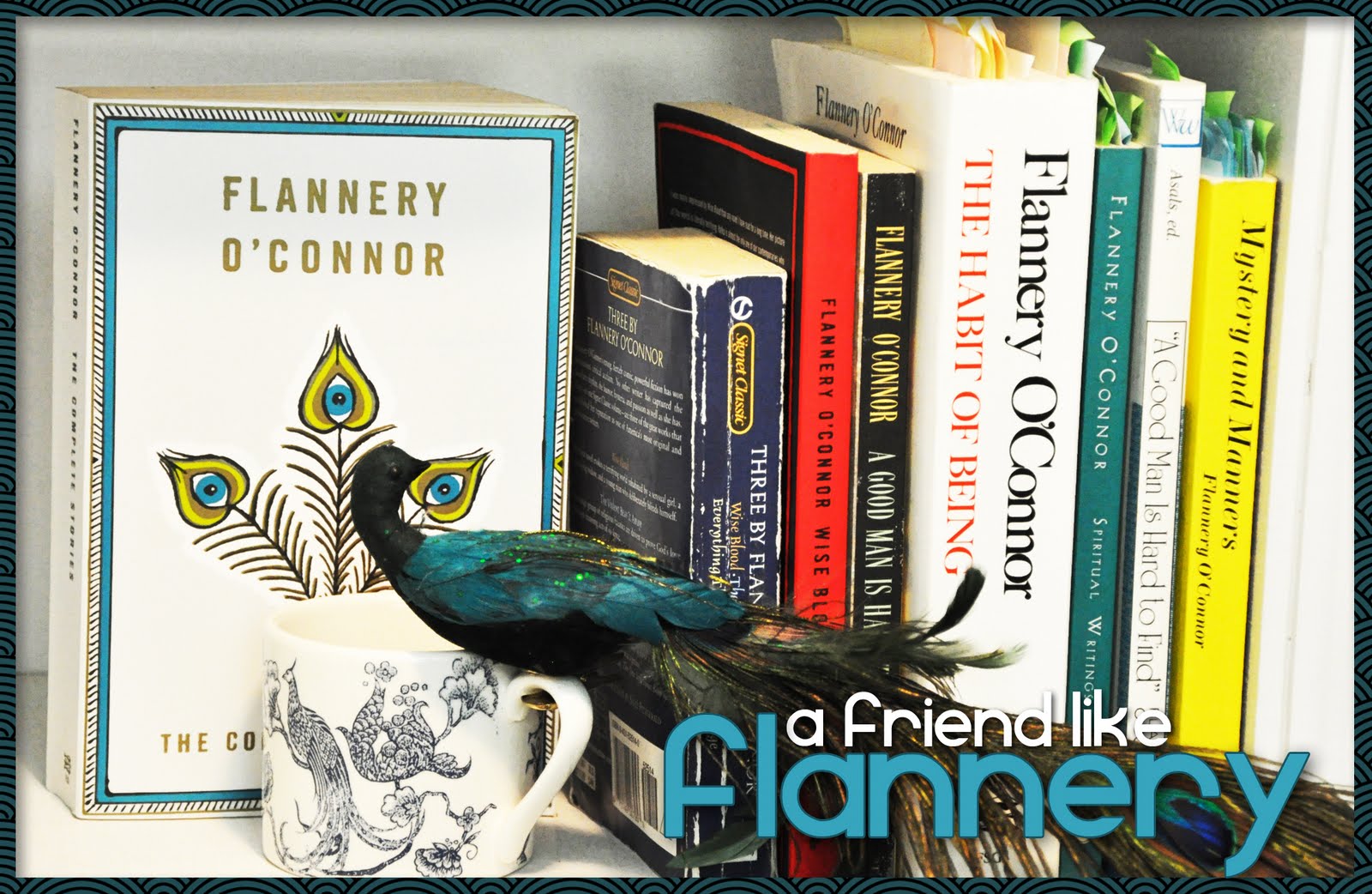
That one brilliant story intrigued me enough to keep reading until I had read all your fiction. And then, because I wanted to know if I was really "getting" any of it or not, I read your papers and speeches and letters, all that they’ve put into books. My copies of these collections are scribbled on with underlinings and notes and exclamation points and question marks and stuffed with a wild variety of colorful bookmarks and sticky Post-it notes, so many that they don’t do me any good. But I can’t help myself. Every time I open one of these books I find something more to mark or exclaim at or make notes on. I must take it slow or go blind from the brightness.
Yours out of the gloom,
A Reader
It’s about time I let you in on how you and I came to be introduced. I had lately decided that with what schooling I did have and the type it was and the age in which it occurred, I had in large part missed out on a classical education and was setting out to fashion one for myself. To begin, I was exploring the best books about reading the best books. Along with Clifton Fadiman's The New Lifetime Reading Plan, I got my hands on The Politically Incorrect Guide to English and American Literature by Elizabeth Kantor (2006), and was finding it wonderfully illuminating. She tells us what’s gone wrong with higher education today and provides a plan to amend the literary wrongs done us. It was as if Elizabeth said (like my dad used to say as he switched on a lamp when he found me reading in a darkening room),“Would you like some light on the subject?”
On page 169 in a big gray text box is “A Mini-Course in American Literature,” what the author calls “a high-speed tour through our whole literature by reading bite-sized pieces of fine American writing from Edgar Allan Poe to Flannery O’Connor.” (Aren't you pleased?) I was to read four tiny poems, five short stories, and two novels. I decided to make my way through this list in a highly conscientious manner. Your “Everything that Rises Must Converge” was one of the short stories, and that’s how we met. (You will surmise correctly that your stories. or parts of them, are now thought of as politically incorrect, but it seems you knew that when you wrote them.)
That one brilliant story intrigued me enough to keep reading until I had read all your fiction. And then, because I wanted to know if I was really "getting" any of it or not, I read your papers and speeches and letters, all that they’ve put into books. My copies of these collections are scribbled on with underlinings and notes and exclamation points and question marks and stuffed with a wild variety of colorful bookmarks and sticky Post-it notes, so many that they don’t do me any good. But I can’t help myself. Every time I open one of these books I find something more to mark or exclaim at or make notes on. I must take it slow or go blind from the brightness.
Yours out of the gloom,
A Reader
Letter #2
Dear Flannery,
I didn’t read your stories or novels until I was as old as they were, that’s half a century, or couldn’t remember if I had. But it’s just as well because before everything important inside me began to change I wouldn’t have understood them. Back then I’m afraid I would have reacted like a great many people reacted when your stories were new and how it seems most still react today. No, I wouldn’t have written you the kind of letter you got from the old lady in California who said that a person who comes home from work at night wants to read “something that will lift his heart,” implying that your stories had not lifted hers. In those days I had plenty of respect for published material just because it was published and I wouldn’t have presumed to tell a famous author what to do. But your meanings would have gone over my head, missing my heart by a mile.
Actually, it’s getting difficult to imagine what I would have thought in the days before everything changed. It’s almost impossible. I seem to be forgetting some of what or how I used to think before ten years ago. The new is doing its best to blot out the old, and in some ways that is good, but I know I must remember it all--- with gratitude.
I must say, though, that I just read your story, “The Lame Shall Enter First,” once again, and knowing beforehand the horrible thing that was going to happen at the end, could only manage it in the light of day. That one does that to me. The consequences of unchecked human nature can be so frightening and tragic. But Sheppard, even he, the false shepherd, the false, self-appointed savior, did finally, at the very end, experience a mighty, wrenching shift inside, and that’s the greatest, most wonderful miracle of all. I like how Leif Enger describes a real miracle: "no cute thing but more like the swing of a sword." Still, you described it more completely as: grace that “cuts with the sword Christ said he came to bring.”
With a lifted heart,
A Reader
I didn’t read your stories or novels until I was as old as they were, that’s half a century, or couldn’t remember if I had. But it’s just as well because before everything important inside me began to change I wouldn’t have understood them. Back then I’m afraid I would have reacted like a great many people reacted when your stories were new and how it seems most still react today. No, I wouldn’t have written you the kind of letter you got from the old lady in California who said that a person who comes home from work at night wants to read “something that will lift his heart,” implying that your stories had not lifted hers. In those days I had plenty of respect for published material just because it was published and I wouldn’t have presumed to tell a famous author what to do. But your meanings would have gone over my head, missing my heart by a mile.
Actually, it’s getting difficult to imagine what I would have thought in the days before everything changed. It’s almost impossible. I seem to be forgetting some of what or how I used to think before ten years ago. The new is doing its best to blot out the old, and in some ways that is good, but I know I must remember it all--- with gratitude.
I must say, though, that I just read your story, “The Lame Shall Enter First,” once again, and knowing beforehand the horrible thing that was going to happen at the end, could only manage it in the light of day. That one does that to me. The consequences of unchecked human nature can be so frightening and tragic. But Sheppard, even he, the false shepherd, the false, self-appointed savior, did finally, at the very end, experience a mighty, wrenching shift inside, and that’s the greatest, most wonderful miracle of all. I like how Leif Enger describes a real miracle: "no cute thing but more like the swing of a sword." Still, you described it more completely as: grace that “cuts with the sword Christ said he came to bring.”
With a lifted heart,
A Reader
Subscribe to:
Posts (Atom)