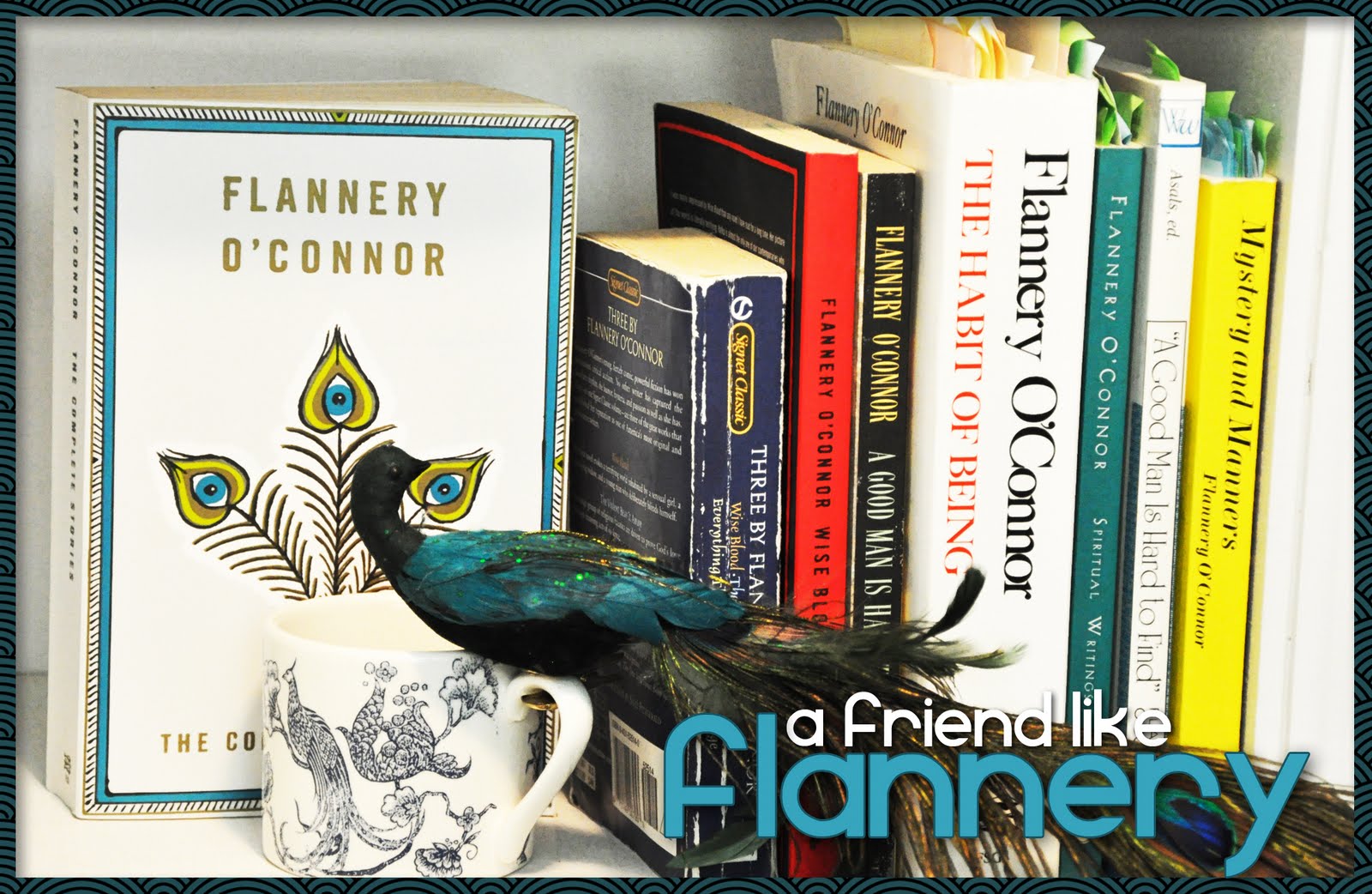
Thursday, December 10, 2015

#22

Dear Flannery,

I know it's been a long time, but I think about you often. Yesterday I had to get out my giant journal again and open it to one of my Flannery pages on which I draw and paste and write all things F.O'C. I was looking for this quote which you wrote in a letter to John Hawkes:

"Cutting yourself off from grace is a very decided matter requiring a real choice, act of will, and affecting the very ground of the soul."


What's happening is that my own people are choosing to do this. People in my church, in my own congregation, my neighbors, my friends, my extended family. Turns out many of them---it appears it may end up being most all of them--- would rather take up the world's various popular banners than stick with God. I totally get it. It's easier. It's more convenient. It's more comfortable. But it's disaster in the making. They don't seem to be able to see past the ends of their noses. They don't see that without truth there is no lasting comfort.

Things have changed a great deal, just in the last few years. How do I describe it? It's a form of terror, but a creeping, silent terror. We do have the regular guns and bombs and blood kind of terror going on, too, and people are being randomly slaughtered at Christmas parties or in restaurants or concerts by Islamist jihadists. But there are worse things than death. The insidious kind of terror is much worse to my way of thinking and actually adds up to more amounts of violence. Violence against innocence, against nature, against God, against freedom, against reality. There are principalities and powers that have taken over completely. Do I sound like some religious fanatic? I'm not. I'm just a regular person who believes in essential absolutes and who believes in the greatest story ever told. For that I am labeled an "extremist," not just by liberals but increasingly by my own people. And yet it is their own brains they have allowed to be washed into smooth dull lumps of  useless gray matter. Evil and insanity is being called love. Good and reality and goodness are being called hate.

But I am being much too cryptic. I'll give you one example. My son reported to me yesterday that a local person is becoming quite famous on the internet's social media. This person is a fifty-something-year-old man who abandoned his wife and seven children to announce to the world that he is actually a seven-year-old girl. He even found himself some people who are pretending to be his parents. I kid you not. There are all sorts of crazy things going on. Come to think of it, you might find it intriguing, what with your pet three-legged chicken. Get this. People are cutting off their healthy body parts to turn themselves into the opposite sex and doctors are doing this for them. Here's the catch, the part you won't go for at all. Most people, yes quite a lot of people, are acting as if this kind of thing is anywhere from just the ways things are to perfectly acceptable,even respectable and worth celebrating.  How does one live in such a world?

I like what you wrote  in a letter to a friend, "You survive in this atmosphere by minding your own business, and by having plenty of your own business to mind; and by not being afraid to be different  from  the rest of them." 

My husband and I don't do much socially anymore. Is this wrong? I just don't have much interest in being with people who have no backbone, who pretend at religion, who surrender their God-given intelligence, not to mention how they have offended to my face my deepest and most sacred beliefs. Nah, I don't think I'm required to party with them. The best I can do is be polite when I am thrown together with them. What I try to remember to do is think of everybody as God's children.

We have many blessings. All our children and grandchildren, and they are quite a few, are with us. They are bright and funny and striving. We also have an eclectic group of new friends who are like-minded with whom we do some underground sort of work.I am very grateful for them, but I've learned not to put too much stock in anybody. People are turning on us regularly. Still, the Lord prepares a table before us in the presence of our enemies. The world is full of interesting and beautiful things to see and do. There is so much to learn. I'm reading a lot. And writing. It's a strange time to be be living here on earth. I feel as if I'm trapped in a lonely filmy dimension between the world and heaven and not a part of either.

I wonder what you would say about it.

J.

Wednesday, October 1, 2014

#21

Dear Flannery,

I've been to another what-you-could-call family values conference and once again realize that I am not fit for polite society. This happens to me again and again, but since the events are few, in between them I forget how to safely conduct myself while I'm there. At these gatherings suddenly I am thrust into human interaction with mere acquaintances. I get to feeling comfortable when it appears that we are wonderfully like-minded and then I say too much. It's like I get greedy. Greedy for heaven I suppose, which I think of as a place where people are together who treasure reality and truth and rightness, all that is God's, above all else. Anyway, in the course of the dialogue, sooner or later, the faces of these people I'm talking with inevitably start to change. They seem to become afraid of something, and I know what. They seem to begin resisting something, and I know that too. But like an idiot I don't want to give up on them. So the conversation goes on and on and finally ends with them lecturing me. It ends with me dissolved into dust which has been ground underfoot and them put back all in one piece on their self-sculpted pedestals. This does not happen because they have won the day; it happens because I let them think they won, because I have placated them and flattered them that one inch which they took as a mile. I guess I don't like to end conversations on a bad note so I take the beating to end it on a good one. Yes, they seem to say to themselves, there are no questions or worries here, all is well, like we thought, like we always think.

No, I don't seem to be getting along with my own people. Maybe I should get some chickens like you did. (I have a friend who has two and actually have been asking her all about them. She gets at least two eggs a day which at least would be useful.)

I emerged from the above experience sorrowing. The thing is, as I talk with these people who are supposed to be on the same side as I am in this beastly culture war in which insanity seems to be increasingly victorious, they reveal themselves to be a new breed of church-institution-based moral relativist. When I suggest that we're losing the battle and that we might need a new strategy, they have all their arguments and excuses lined up neat and tidy. (And by losing the battle, I mean for individual souls; I know we're going to lose the war itself.) Hit unaware from behind by the devil, they refuse to admit they've been hit unaware from behind by the devil. They love to say, well, how can we win them [sinners] over unless we speak a certain way in certain words, unless we are compaaaasionate, unless we welcome them, unless we excuse their wickedness and call it a less condemning name? Do they not know that sin by any other name is still sin? I think they've convinced themselves it isn't! Truly! I suppose they apply this craziness to they themselves also and this is why they themselves don't use the words sin and repentance and redemption anymore hardly at all when it comes to anyone or anything.

Seriously, in religious/church forums, for sexual sins we now use words like problem and burden and addiction and pain and struggle instead of proper words like sin and wickedness. Apparently these really sleazy things people decide to do are nobody's fault anymore. Iniquity is not a choice; it's an involuntary psychological condition. They don't even admit that sin is pleasurable! Why else would anybody do it? It's astounding. In addition, they are what John Milton described as perfectly eager to shift off their personal religiousity onto some other human being or beings and blindly follow whoever's in charge at the moment rather than have to do any thinking or questioning or exercising faith in . . . what? Only  therockofourRedeemerwhoisChristtheSonofGod! Sorry. It's just astonishing.

In the meantime I proved to be a bit of a mess. It's so weird how our physical bodies sometimes (or maybe always?) respond to spiritual or emotional stress. In my case that day it was obvious and immediate. As I stood there being persecuted by my friends for my scriptural beliefs in timeless and obvious truths, my knees---one and then the other--- would take it upon themselves to jiggle up and down something awful for minutes and minutes! Violently, I would say. I don't know which was more frightening, the treacherous words coming out of these self-satisfied people's mouths or my own body reacting to them.

And to think I traveled across practically the whole country to go to this conference and be frightened out of my kneecaps. Well, at least one of our daughters and her family live there and we stayed with them and I got to be mauled by a chubby over-affectionate 10-month-old grandson for a week to balance things out.

Oh! On this trip I finished A Good Man is Hard to Find, the short story collection, once again which helped restore my peace and sanity. I read some out loud to my daughter one evening, the last two paragraphs in "The Artificial Nigger." (By the way, nobody, I mean nobody, except black people, can say that word anymore; it's referred to as the "N-word.) You wrote in a letter that the ending of this story gave you a lot of trouble, which trouble I am very glad you took.

 At home, putting myself back together, and considering becoming a hermit,
J.

Friday, September 19, 2014

#20

Dear Flannery,

 Now I've picked up A Good Man again and like Annie Dillard said, when I see the Rembrandts I want to paint, as always when I read your stories I want to write.I see that my stories have to be much better than they are. Dragged out my twelve unfinished stories and am working on one called "Earth Day." It's the one I've worked hardest on and the one closest to finishing. I'm having great fun as, like you, I "enjoy retrieving them better than I do writing them" from scratch (Habit of Being, 67). This part is like play.

So I wanted to enter a short story contest I caught a glimpse of but on further investigation I don't think I can. None of my stories fit in any of the genres from which I am required to choose: Thriller, Horror, Crime, Young Adult, Romance, Science Fiction/Fantasy. I can't for the life of me cram any of them into any of these although I suppose they have elements of a few: people die in horrifying ways and one has a pathetically wrong sort of romance. Then I thought, what genre are Flannery's stories? I never think of them in any genre. They are just great. Of course people say your stories are Southern Gothic. I think this is a very narrow genre to squeeze your stories into. And not accurate either, but I suppose they had to come up with something literary. "I am a writer with Christian concerns," you said yourself, but they ignore that statement and many others like it. How silly, don't you think? Sorry to say, these interleckshuls will do anything to sidestep God.

I am not writing stories set in the south. They are set in the west and southwest. But I do hope they are "Christ-haunted" as you say. Is that supposed to be the gothic part?  The current cultural consensus is that "goths" are young people who dress all in black and die their hair all sorts of crazy colors and have a lot of piercings and tattoos and chains. I wouldn't be surprised to see monstrous jewel-encrusted crosses--what now serves as costume jewelry--- as part of their ensemble. Hey, Parker would fit right in! Maybe our whole country has been invaded by Southern Gothic now.You can see them at any school or shopping mall. Freaks: misled, misfitted, melodramatic.

I see how the freaks work in your story. I can't hope for freaks. I am having a hard time coming up with interesting enough characters even though I suppose I am thought of being somewhat freaky myself these days in this my neck of the woods; it appears people have to work a little at being charitable towards me. A while back one of our old friends remarked, "You guys used to be fun, before you got religious." This is a friend we only know from our church, with whom we sing hymns and participate in religious rites and rituals. And yet like Mrs. McIntyre in "The Displaced Person," Christ seems to be quite a nuisance to this friend who resists even the most basic Christian certainty, such as what the priest said, "He came to redeem us."  Now that I think about it, I suppose I can find characters along your Christ-haunted genre freak spectrum right here. And I'm happy to be in that number.

My stories began much too bland and nice. The more I work on them the more they are becoming endowed with sharpness and distortion and caricature. I can see it makes them much better. I was working along today and saw little things that needed to be fixed so clearly. I changed she called out to she cried out in a screech like a magpie. And washed-out jeans to oil-and-dust-stained jeans. Exposed to glared bare naked.  Complacent light to pale apathetic yellow. It's such a challenge to exchange the ordinary word or phrase to a sharp distorted corlorful one. I call it uglifying the story. For someone unassuming like me it feels like vandalizing, spray painting huge shocking gang signs in public places. But it's really just making the story more accurate and vivid and real and important. I hope.

This really isn't me.It's a great stretch. I love it.

I don't know what genre my stories belong in. Like yours, they're about who we really are and how we really need Christ but don't want him. Well, they just have to be good enough to defy genre.

Yours certainly are.

J.

Monday, August 25, 2014

#19

Dear Flannery,

I'm reading Everything That Rises Must Converge again and loving every perfect word. I mean, "Both their grins became gelid."? Had to look that one up. I don't know which of your story collections I like best. They are all so . . . right. And hilarious. I read some to my husband from "The Enduring Chill" (is this your funniest?) and he laughed and laughed at the part when the conscientiously "dying" Asbury wants to have a smoke with Randall and Morgan. Ha! Poor Azberry.

But I am often caught off-guard. You make these stories so real, so concrete, as in "The Comforts of Home."  "From one of the upper windows a crumpled piece of paper blew out and drifted down." Little deatils like that go technicolor and I am so immersed in the movement and places and images and vividly accuatate human emotions that I must often shake myself and remember that these stories are not just what they appear, rather they are deeply metaphorical in their meanings. For instance, in "Greenleaf" I don't mourn for Mrs. May because she actually gets gored by a charging bull through her flesh-and -blood heart, I mourn for Mrs. May because she can't see that Christ (the annoying horn-wreathed bull that's always trying to get her attention in mundane everyday ways) wants to enter and change her miserable soul. Someone said humor is an acceptance of life, and we could add that humor is also an acceptance of humanity's fallen blind-and-deaf ridiculousness.

I must say that "A View of the Woods" is pretty wild, the greedy old man smashing his little granddaughter's head against a rock like that and all. But I think I get it. He's that selfish and that egoistic, but he ends up killing the thing he loves most: himself (or what he was sure was an exact mirror-image of himself). But that breaks his heart, which is a start. Is it too late? 

Now "The Comforts of Home" always throws me. I had to think hard about it. You said somewhere that maybe all we can do nowadays is at least point out there is a devil and evil of all kinds, and a need for soul-deep redemption, that that might be as far as we can get. So I think that might be what this story is. But Sarah Ham, although a ham and a silly, manipulative, naughty, unfortunate girl, is not really the evil one. Thomas is indulged, jealous, selfish, and self-righteous. He is the one to see that is at fault. His well-intentioned but clueless mother accidentally getting killed through his machinations to incriminate Sarah is a chance for him to see himself for what he really is. I hope that's somewhere in the ball park.

At the moment I am doing more thinking about my own stories than actually putting fingers to keys. I love your signature color-drenched sun and sky and woods and lines of trees references and thought I could use the close huge imposing mountains where I live in my stories. So I'm observing these aspects of my surroundings more at different times of day, in different weathers to get some ideas. In one certain story I want to add something about how the mountains enclosed the perimeter of the valley, their gargantuan dirty green shoulders and elbows and rumps heaped up high like those of guilt-ridden sinners nevertheless refusing to totally prostrate themselves. Work in progress.

Thanks for your indescribably meaty and delicious stories.
J.


Friday, January 11, 2013

#18

Dear Flannery,

I'm still working on my stories in between living my life. No, they're not ready. Every time I think I am finished with one, I wait a while and then read it only to find out it wasn't finished at all, that there are all sorts of things to work on and delete and fix. Oh well. I do think they are getting better than they were. But as for being any good at all I don't know. I do have fun working on them though, if you can call it that. Maybe quiet joy is more like it, just to write about the things that matter most in a creative way.

I was visiting a friend the other day, enjoying her library, and borrowed a monograph about you by Dorothy Tuck McFarland, copyright 1976. (Perhaps you know how people have continued to study your work ever since you left us.) It was wonderfully illuminating. I had to get my own copy. I think she gets you and your stories mostly right, that is, if I do, and I learned a lot. I was so blown away all over again by your --- what should I call it? Craftmanship? Imagination? Genius? Sense of humor? Focus? Insight? Vision? Daring? Persistence? Love? Yes, all of the above.  

I was reading one of my stories to my husband last night (he insisted) and he actually laughed. "She's funny!" he said, about my obnoxious character, which was a great compliment. I had gone through the story that day and, among other things, taken out all the pretty words I could and exchanged them for, I don't know, not so much ugly words as realer words. Those too-nice words just ruined the tone in spots, you know? An example: "swirl of" was changed to "riot of" (as in red dust from a swerving car). And  "threaded" which was boring became "needled" (as in fingers through hair). Too much? Another example: "painted" to "lashed" (as in markings on sandstone cliffs). "prosthetic" to "fake," "drifting" to "stray" (as in sand). Have I overthought? Time will tell. Sometimes I just get too wordy, period, which makes me want to throw up when later I see the awful phrases I once put down so confidently.

How, how, how did you do it?

J.

Wednesday, January 18, 2012

#17

Dear Flannery,

I am writing. Stories. It's tortuous and discouraging and fun. I started them years ago and they have sat and waited most of that time. I have revised them periodically, hoping to improve them, and am now determined to finish them off, as far as I can do it.

I have also been reading a great deal, 75 books this past year and 80-something the year before. My reading and rereading of excellent writing (including yours) I hope will help improve mine. I don't think I have a gift in that way; I have to work very hard, but then maybe that dogged willingness is a gift itself, my gift. I do have a lot I want to say that is of the greatest interest to me and, from what I've read, to you, and to many thoughtful people.

My stories are not at all what I would have thought they'd be in my younger days when I dreamed of writing. The "sugary slice of inspirational pie," as you put it, was burned out of me some years back, thank goodness. No, they are not sweet. They are not Do Unto Others stories. They are not massage therapy. They are, or are meant to be, heart surgery. They are dark stories. Darkness through which I hope Light will become intelligible. Bad things happen in them. Badness against which real goodness can be seen in contrast. At least I hope they are those things. Your stories, written with such skill that people think they are great even if they don't get them, are my teachers, my ideals. While I can't seem to think up such "large and startling figures" as you did, and I don't know if I am "shouting" as loud as you did, literarily speaking, I do know your audience hasn't changed, except to get blinder and deafer.

I wish you were here to read my stories and tell me what you think of them, like you did with your friends while you were here. But alas, you are gone. How can I know if they work? I did get some interest in one of them a while back. But after two or three back-and-forths, the editor quite suddenly backed out. I suppose it just wasn't good enough.

What I want to do is get out of my box. The only way to do that is to write better, in a bigger way. I don't want to write stories for or about members of my particular church. I want to write stories for and about human beings.

I am in the process of doing just that. I have 12 stories to work with. They need tweaking. I've tweaked two so far and I think it's working, although it's like wrenching my brain out of my head. I am getting to like these new versions a little. May I send you a story? Or pretend to?

Wishing you were here,

J.

Thursday, November 10, 2011

Lettter #16

Dear Flannery,

I made a mistake in buying a book written by a couple of "interleckshuls." You spelled it something like that. Ha-ha.

It's really not so funny. The book seemed to hold such noble promise, especially with such a resplendent title as All Things Shining, and such an intriguing subtitle as Reading the Western Classics to Find Meaning in a Secular Age. With our modern technology providing access to every book in existence, old and new, new and used, my money was winging through cyber-space with the touch of a few buttons on my computer and the book arrived in my mailbox in a few days.

Halfway through I have ground to a disappointed halt. I begin to see what university professors Dreyfus and Kelly are about. And it's too bad. Oh they begin very well by pointing out how our modern secular culture has become based on nothing, nihilistic, empty of purpose and meaning. They show how destructive this is for everyone and everything. They make a good case for how ridding the world of all things sacred has caused us to feel lost and sad. But here's the rub (meaning impediment--I've come to Shakespeare in my Lifetime Reading Plan and just finished Hamlet. It's rubbing off on me.) They totally misrepresent Christianity, saying it's all about Jesus' love being a "mood" which is something you can magically catch by "hanging out with him" (like the chicken pox?) that will make you want to, say, give your life for others supposedly like he did. What they mean by this is that Christianity is all about just being a nice person, which of course need not be a religious undertaking at all and in that case most of us don't need any Divine Redeemer. Strange, they don't seem to wonder why he gave his life. But it doesn't matter anyway because  these guys later point out that Christianity won't do because it's all about "embodiment" and they want something abstract, outside us, something that transcends. Too bad they didn't do their homework.

Belittling and misunderstanding Christ in the midst of all their learnedness, these authors decide we should all go further back, B.C., to Homer's representation of the lofty ancient Greek polytheism. (Funny, in my recent studies I found that world clouded over with multiple gods and demi-gods who often thought and acted like flawed capricious humans with some superhuman powers dispersed among them, more like super-dangerous humans than gods.) I suppose the last half of the book is going to tell me why a new age polytheism is such a good idea. Ho-hum. Trumping up any old meaning to try and make sense of this meaningless secular world is not good enough for me. I wonder why it should be good enough for anybody.

It may be that they have been convinced that Christianity has to be false or lacking, so they don't bother to study into it in any depth. That's a popular view. And yet they admit it changed the world radically, like nothing else. Methinks these interleckshuls doth protest too much. It seems they must arch and twist and contort their cluttered brains for a way to avoid Christ, like a couple of bookish Hazel Moteses. Again, from Hamlet,

Their words fly up, their thoughts remain below.
Words without thoughts never to Heaven go.

J.